The integration of smart technology into the bedroom has always been a delicate balancing act. For nearly a decade, hardware manufacturers pushed fully fledged smart displays into our private spaces under the assumption that consumers wanted to stream videos, browse photo albums, and make video calls directly from their pillows. However, this trend sparked a quiet but persistent backlash driven by privacy concerns over active, internet-connected camera lenses trained on the bed.

Amazon’s original answer to this dilemma, the circular Echo Spot launched in 2017, was plagued by screen flickering issues and eventually discontinued. Seven years later, the tech giant resurrected the moniker with the Amazon Echo Spot (2024 Release). This completely re-engineered device attempts a radical design pivot: it strips away the integrated camera entirely and divides its front face between a basic, non-video-capable color display and a fabric speaker mesh.
Positioned cleanly between the screenless Echo Dot and the fully visual Echo Show 5, the 2024 Echo Spot is explicitly built from the ground up to be a dedicated smart alarm clock. But when an enterprise intentionally reduces hardware functionality while charging a premium over its core smart speakers, it forces an essential question for smart home enthusiasts: Is the Echo Spot an elegantly focused, privacy-first bedroom asset, or is it an overpriced, heavily compromised hybrid that leaves buyers stranded between two worlds?
At WorStor.com, we strip away marketing hype and corporate spin. This independent analysis dissects the engineering, real-world utility, and long-term value of the Echo Spot to determine exactly where your capital should go.
Product Overview and Technical Specifications
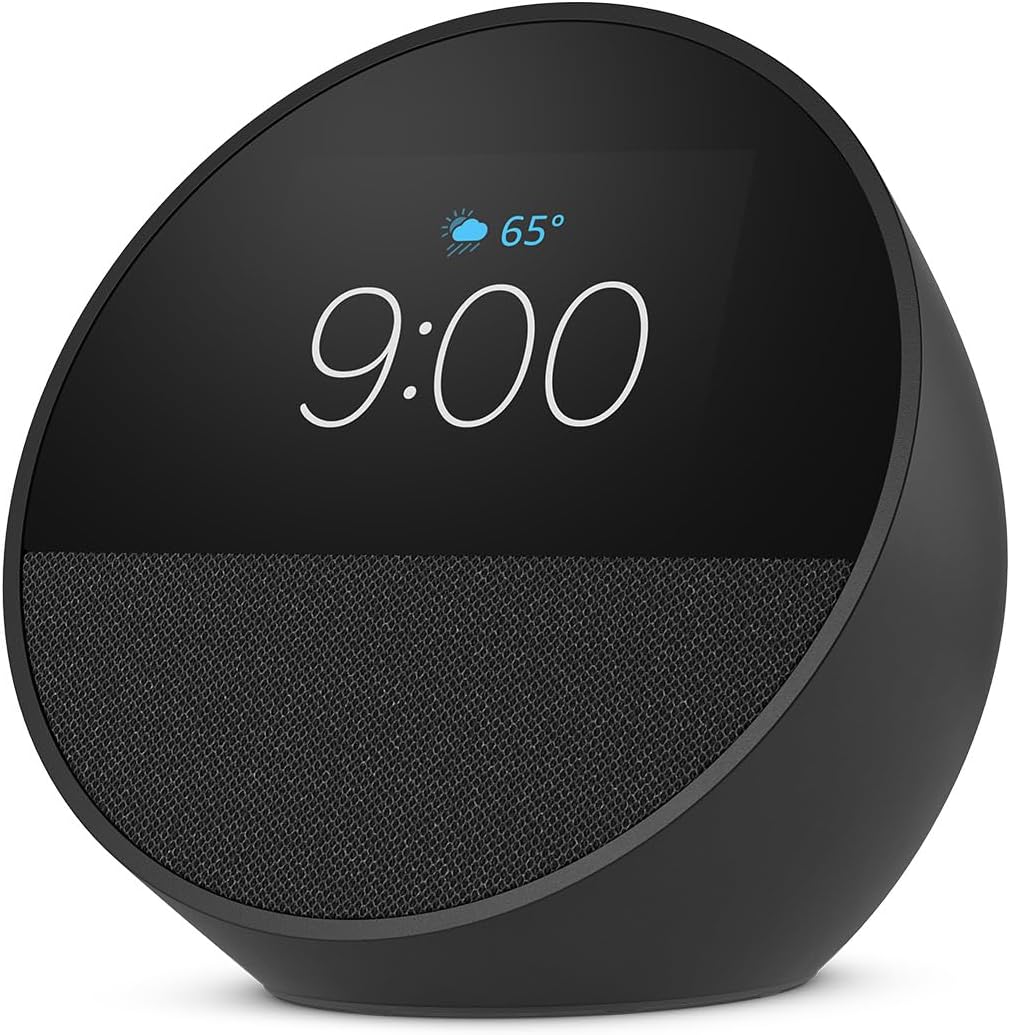
The Amazon Echo Spot (2024) is a compact, semi-spherical smart speaker featuring an upward-angled, flat front face. Architecturally, it resembles a cross between the budget-tier Echo Pop and a classic desk clock. It measures 113mm x 103mm x 111mm and weighs 405 grams, giving it a stable, solid footprint that fits easily on crowded nightstands without slipping.
Core Technical Specifications:
- Display: 2.83-inch diagonal color touchscreen with a native resolution of 320 x 240 pixels. The physical display panel is rectangular and occupies only the upper half of the circular front face.
- Acoustic Driver: Single 1.73-inch forward-firing mono driver, identical in physical diameter to the acoustic element found in the fifth-generation Echo Dot.
- Camera Architecture: Explicitly zero. No camera lens, physical shutter, or optical sensor is integrated into the chassis.
- Microphone Array: 3-microphone far-field array mounted on the upper rim alongside physical volume controls and a hardware microphone mute switch.
- Wireless Connectivity: Dual-band Wi-Fi 5 (802.11ac) and basic Bluetooth receiver compatibility.
- Smart Home Interoperability: Functions as a Matter controller over Wi-Fi, allowing basic local execution of verified smart home components.
Amazon handles out-of-the-box initialization via the standard Alexa app on iOS and Android. Upon initial power delivery from its 15-watt AC wall adapter, the display renders a localized QR code that syncs the speaker directly to an Amazon account and regional Wi-Fi credentials within minutes.
Part 1: The Weaknesses (The Worst)
While the Echo Spot handles standard bedside duties capably, an investigative look at its hardware boundaries reveals glaring limitations that will frustrate power users and connected-home veterans.
1. The Heavily Restrained, Non-Video Display
The presence of a color touchscreen naturally sets user expectations for visual versatility. However, the Echo Spot’s 2.83-inch panel is strictly prohibited from rendering full-motion video. The integrated display processor lacks the hardware acceleration and codec pipelines required to decode video streams from online platforms like YouTube or Prime Video.
More critically, this limitation extends directly into smart home monitoring. If a visitor rings a Ring or Blink video doorbell, the Echo Spot cannot display the live video feed. Instead, the device plays an audio chime, and Alexa verbally states that “cameras do not work on this device.” For a product anchored in a smart home ecosystem where visual doorbell integration is a standard convenience, this architectural ceiling forces users to pull out their smartphones to identify guests.
2. Poor Off-Center Viewing Angles and Reflection Traps
The glossy polycarbonate layer protecting the upper half of the clock face is highly reflective. In bright bedrooms with large windows or overhead lighting arrays, the screen turns into a mirror, washing out the low-resolution 320 x 240 display.
Furthermore, the display panel utilizes a cheaper display alignment that exhibits significant color-shifting and brightness drops when viewed from off-center angles. If the device sits on a nightstand that is elevated significantly above or below your eye level—or if you attempt to glance at the time from a sharp angle while lying down—the text becomes noticeably dim and difficult to read.
3. Total Elimination of External Audio Outputs
In a baffling design move, Amazon completely omitted physical and wireless audio-out capabilities from this iteration. There is no 3.5mm auxiliary port on the rear of the device, nor does the firmware support outbound Bluetooth audio transmission to external sound systems.
This means you are completely locked into the internal 1.73-inch mono driver. If you wanted to use the Echo Spot as a visually striking bedside clock while routing its music streaming into a premium set of external powered monitors or a dedicated bedroom soundbar, the hardware prevents it entirely.
4. Acoustic Distortions and Wake-Word Failures at High Volume
The single forward-firing mono speaker is tuned aggressively to punch above its weight class in low-frequency response. However, when the volume is pushed beyond 70%, the small internal amplifier struggles. Mid-range frequencies become muddy, and high-end notes display noticeable harmonic distortion and harshness.
This acoustic strain directly compromises the device’s smart capabilities. When music or podcasts are played at high gains, the internal vibrations overwhelm the 3-microphone array. Users will find themselves forced to shout the Alexa wake-word multiple times to interrupt playback, as the noise-cancellation algorithms fail to isolate voice commands from the internal speaker output.
5. Stripped Sensor Architecture
Unlike the fifth-generation Echo Dot, which includes an integrated ambient temperature sensor to trigger smart home climate automations, the 2024 Echo Spot leaves this hardware out. It also cannot act as an Eero Wi-Fi mesh extension node. Buyers are effectively paying a premium for a device that lacks the core environmental tracking and network-routing utilities found in Amazon’s cheaper, screenless pucks.
Part 2: The Strengths (The Good)
Despite its structural limitations, the Echo Spot (2024) excels inside its intended operational boundaries, offering specific refinements that make it a highly functional bedside companion.
1. Absolute Hardware Privacy
By entirely omitting a camera from the blueprint, Amazon eliminated the single largest hurdle to bedroom smart display adoption. There is no physical privacy shutter to manage, no digital lens disable toggle to trust blindly, and zero risk of a remote firmware exploit compromising your personal space. For privacy-conscious consumers, this clean, camera-free facade offers true peace of mind that software-disabled lenses cannot replicate.
2. Specialized Bedside Audio Tuning
While the 1.73-inch mono driver falls flat at high volumes, it is beautifully balanced for near-field, lower-volume listening. Unlike older Echo models that utilized down-firing or omnidirectional drivers that vibrated nightstand surfaces and created boomy, indistinct bass, the Spot’s driver fires directly forward.
This directional design delivers superb vocal clarity for spoken-word content, such as audiobooks, morning news briefs, and podcasts. At typical bedside volumes (between 30% and 50%), the audio is crisp, intimate, and perfectly prioritized for solo listening.
3. Flawless Ambient Dimming and Night Mode Physics
As an alarm clock, the device handles light pollution with surgical precision. The integrated ambient lux sensor evaluates room brightness instantly. When bedroom lights are extinguished, the display immediately sheds its vibrant daytime blue and white color palette, shifting to a muted, low-energy amber or deep red hue.
Because red light does not disrupt human melatonin production or damage dark adaptation, the clock face remains legible throughout the night without casting a ambient glow across the room.
4. Intentional UI Aesthetics and Tactile Controls
Amazon’s Echo Show displays are frequently criticized for cluttering screens with unprompted recipe suggestions, sponsored advertisements, and intrusive news headlines. The Echo Spot completely avoids this digital noise. Its interface is minimal, elegant, and focused.
When playing music, the screen renders clean, abstract audio visualizers and vibrant album art thumbnails. When an alarm triggers, the Spot utilizes an internal ultrasound motion sensor to enable a physical tap-to-snooze function. Sleepers can firmly tap the top of the polycarbonate shell to delay the alarm, avoiding the need to open their eyes or search for small physical buttons in the dark.
Part 3: Long-Term Ownership Experience
Investing in a smart home ecosystem requires analyzing how hardware holds up over multiple years of continuous deployment. The 2024 Echo Spot presents a distinct set of long-term ownership variables:
Material Degradation and Cleaning Dynamics
The chassis is split between a matte polymer back shell and a high-gloss, translucent acrylic front shield covering the display. This glossy front face is an absolute magnet for fingerprint oils, airborne dust, and micro-abrasions. Cleaning the surface requires careful maintenance; wiping the screen with standard paper towels or abrasive cloths will quickly cause permanent micro-scratching. Owners must use clean microfiber cloths and avoid harsh chemical solvents that can degrade the plastic polymer over time.
Ecosystem Lock-in and Local Execution Stability
The Echo Spot is completely tied to the Amazon Alexa cloud platform. If your residential internet connection drops, the device loses almost all smart utility, though local alarms set on the device will still trigger.
On the positive side, its integrated Matter-over-Wi-Fi controller architecture ensures that as the smart home industry standardizes around Matter, the Spot will maintain its ability to trigger basic local smart switches and lighting arrays. However, because it lacks a Thread border router or a Zigbee chip, it cannot serve as the primary network backbone for an expansive smart home setup.
Software Lifespan and Chipset Overhead
Historically, Amazon support pipelines keep Echo devices updated for at least four years post-discontinuation. However, because the internal processor is running a modern visual UI on lightweight hardware, future Alexa feature rollouts could slowly impact system responsiveness. Users should anticipate a slow deceleration in menu transition speeds over a 3-to-5-year operational lifecycle, a pattern well-documented across previous lower-tier Echo iterations.
Part 4: Performance Matrix
To simplify the evaluation of the Echo Spot (2024), we have mapped its real-world performance across key operational categories:
| Category | Verdict | Practical Reality |
| Build Quality | Good | The semi-spherical chassis feels structurally dense and firmly anchored by its rubber base, though the glossy front face scratches easily. |
| Ease of Use | Elite | Minimalist UI eliminates the distracting visual bloat of larger displays. The physical tap-to-snooze function is mechanically flawless. |
| Performance | Mediocre | Fast enough for basic clock swaps and alarm triggers, but exhibits noticeable UI frame-drops when processing complex routines. |
| Features | Worst | Severely stripped. No video support, no security camera streaming, no temperature tracking, and no auxiliary audio outputs. |
| Value for Money | Mediocre | At full retail pricing, you are paying a heavy premium strictly for a tiny touchscreen and a minimalist clock interface. |
| Reliability | Good | Local alarms trigger reliably without internet connections, and smart home lighting states sync quickly via Matter. |
| User Experience | Good | For bedroom deployment, the non-intrusive Night Mode and lack of a camera create a highly comforting, functional user cycle. |
Part 5: Competitive Comparison
To understand the Echo Spot’s true market position, we must compare it directly against alternative bedroom smart options:
1. Echo Spot (2024) vs. Echo Show 5 (3rd Gen)
The Echo Show 5 features a larger 5.5-inch rectangular display and an integrated 2MP camera with a physical privacy shutter.
- Advantages of the Show 5: It is a true smart display. It streams full video, displays live feeds from Ring doorbells, and often retails at a comparable price point during major sales.
- Disadvantages of the Show 5: The screen is noisy, frequently displaying unwanted ads, news articles, and notifications. Even with the physical camera shutter closed, many users remain uncomfortable with a camera housing facing their bed.
- The Verdict: Choose the Show 5 for kitchens or desks where video streaming matters; choose the Spot for pure bedside privacy.
2. Echo Spot (2024) vs. Echo Dot with Clock (5th Gen – Legacy)
The discontinued but widely owned Echo Dot with Clock utilized a simple dot-matrix LED display embedded beneath its fabric wrap to show the time, outdoor temperature, and brief text strings.
- Advantages of the Dot with Clock: It included a built-in room temperature sensor, occupied less physical space, and cast absolutely zero ambient light reflections due to its fabric exterior.
- Disadvantages of the Dot with Clock: The display was entirely non-graphical and could not show album art, rich weather animations, or customizable color configurations.
- The Verdict: If you can still find a Dot with Clock and only care about checking the time in the dark, its extra environmental sensors provide better functional utility. The Spot is purely an aesthetic, visual upgrade.
3. Echo Spot (2024) vs. Google Nest Hub (2nd Gen)
Google’s bedroom solution utilizes a 7-inch camera-free display that leverages Soli radar technology for sleep tracking and air gesture controls.
- Advantages of the Nest Hub: Completely camera-free yet fully capable of playing YouTube videos and displaying Google Nest security camera feeds. It features a superior interface for managing smart home groups.
- Disadvantages of the Nest Hub: The massive 7-inch footprint consumes significant nightstand space and can feel visually overwhelming in a dark bedroom. Its audio lacks the low-end warmth of the Echo Spot.
- The Verdict: If you are anchored in the Google Assistant ecosystem and want video capabilities without a physical camera lens, the Nest Hub is a vastly more capable smart display.
Part 6: Buying Verdict
❌ Do NOT Buy This Device If:
- You own a video doorbell or security cameras: The firmware’s complete inability to fetch camera streams makes it a frustrating dead-end for home security monitoring.
- You want a media-consumption device: The lack of video decoding codecs and the total absence of a 3.5mm or Bluetooth audio-out channel blocks all media flexibility.
- You are hunting for maximum features per dollar: From a pure hardware perspective, paying a premium over an Echo Dot for a small, clipped 2.83-inch screen that cannot play video is a poor value proposition.
- You require multi-room audio routing: The lack of physical and wireless audio outputs means this speaker cannot easily integrate into legacy home audio configurations.
✅ This Is a Great Buy If:
- You demand absolute bedroom privacy: The complete absence of a physical camera lens ensures total security without relying on software toggles or plastic sliders.
- You want a premium, distraction-free clock face: The clean UI completely eliminates the irritating ad loops and news pop-ups that plague the Echo Show lineup.
- You listen to spoken-word audio at bedtime: The forward-firing 1.73-inch driver is masterfully voiced for crisp, articulate vocal delivery at lower volumes.
- You are highly sensitive to nighttime light pollution: The aggressive automatic dimming curve and automated shift to dark red/amber clock face fonts are world-class for sleep hygiene.
Final Verdict
- Overall Structural Score: 6.8 / 10
- Best Use Case: Dedicated bedside smart alarm clock and near-field podcast/audiobook speaker.
- Primary Strength: Total camera-free privacy paired with an outstanding, low-glare dark room auto-dimming display profile.
- Primary Weakness: Aggressive software limits that reject all smart home camera video streams and external audio routing.
The Amazon Echo Spot (2024) is a highly specialized piece of hardware. By stripping away video capabilities and the camera lens, Amazon successfully cured the digital bloat and privacy paranoia that ruined previous bedroom smart displays. It looks beautiful, sounds great at low volumes, and handles sleep hygiene flawlessly. However, by blocking smart doorbell feeds and eliminating basic audio outputs, Amazon created a set of limitations that are difficult to ignore. If you want a premium, ultra-private alarm clock and are comfortable with its strict boundaries, the Spot is an excellent luxury buy. If you want a true smart home control center, look elsewhere.
Product Gateway
To review current color options, check promotional pricing adjustments, or inspect localized availability details, you can visit the official marketplace entry directly:
Part 7: The Cross-Examination (FAQ)
Can the Echo Spot (2024) display my personal photo albums like an Echo Show?
No. The display architecture on the Echo Spot is restricted to basic widgets, simple animations, and album art thumbnails. It lacks the storage, processing framework, and interface layout to link with Amazon Photos or display continuous personal photo slideshows. The screen is designed strictly to be a clock face and information tracker, not a digital photo frame.
Does the tap-to-snooze function require me to hit the touch display directly?
No, and that is one of its best design features. The Echo Spot uses an internal ultrasound motion sensor that detects structural vibrations and proximity shifts. You can firmly tap or slap the top or side of the plastic casing itself to snooze the alarm. This prevents you from accidentally smudging the glossy screen or having to precisely aim your hand in total darkness.
If the internet goes down overnight, will my morning alarm still trigger?
Yes. The internal memory chips of the Echo Spot retain your scheduled alarm profiles locally on the hardware. If your home Wi-Fi network drops out mid-night, the local hardware clock will still trigger your alarm at the designated time. However, be aware that if you use a music streaming service or a custom smart home routine as your alarm wake-up method, the device will fall back to a standard internal default chime due to the loss of internet connectivity.
Can I pair two Echo Spot (2024) units together for stereo sound?
Yes. Through the Alexa mobile app, you can configure two identical 2024 Echo Spots to operate as a stereo pair over your Wi-Fi network. This splits the audio channels into distinct left and right outputs, which can significantly expand the soundstage if you have matching nightstands on both sides of a bed. However, you cannot pair an Echo Spot with an older Echo Dot or an Echo Show to create a stereo configuration.
Does this device have a built-in battery for portable use?
No. The Echo Spot (2024) is strictly an AC-powered device. It must remain continuously plugged into a wall outlet using its included 15-watt power adapter. There is no internal rechargeable battery, nor are there official first-party battery bases available for it. If you unplug the device to move it to another room, it will instantly shut down and cycle through a full reboot sequence once power is restored.
Why does the screen look slightly blurry or washed out when viewed from the side?
This is a physical limitation of the specific display panel technology Amazon selected for this device. The screen has constrained viewing angles. While it looks sharp and vivid when viewed directly from the front, looking at it from a steep side angle or from far below eye level results in a natural physics drop-off, causing colors to invert and the text contrast to degrade significantly.